The National Child Traumatic Stress Network
Published on The National Child Traumatic Stress Network (https://nctsn.org)

Home > Justice System Professionals

Children who come to the attention of the juvenile justice system are a challenging and underserved population. The National Child Traumatic Stress Network has developed resources to help juvenile justice professionals understand and provide trauma-focused services to these youth. These resources include tools and materials for building skills and increasing knowledge about childhood trauma to help judges, attorneys, law enforcement, probation officers, frontline residential staff, mental health personnel, and caregivers understand and respond to the needs of traumatized children. In addition to the NCTSN resources highlighted below, Justice System Professionals can learn more about creating trauma-informed Justice Systems in the Trauma-Informed Care section of this website.

NCTSN Resource

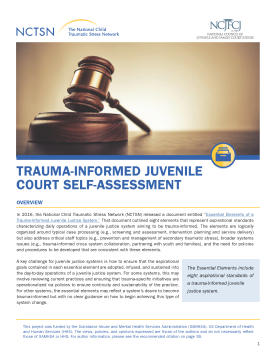
Trauma-Informed Juvenile Court Self-Assessment [1]

Type: Special Resource

Provides a juvenile justice system with a framework to examine, review, and rate day-to-day operations with a set of benchmarks to evaluate to what extent court operations reflect the content, process, and systems-level procedures reflected in each essential element.
view [1]
NCTSN Resource

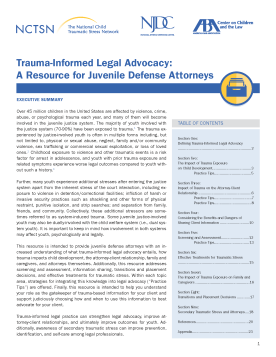
Trauma-Informed Legal Advocacy: A Resource for Juvenile Defense Attorneys [2]

Type: Resource Guide

​Provides juvenile defense attorneys with knowledge about trauma, the definition of trauma-informed legal advocacy, the impact of trauma exposure on child development, and effects of trauma on the attorney-client relationship. 

view [2]
NCTSN Resource

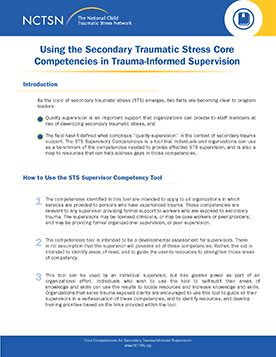
Using the Secondary Traumatic Stress Core Competencies in Trauma-Informed Supervision [3]

Type: Fact Sheet

Discusses the importance of quality supervision that organizations can provide to staff members at risk for secondary traumatic stress (STS).

view [3]
NCTSN Resource

The NCTSN National Juvenile Probation Officer Survey [4]

Type: Special Resource

Details the results of a nationwide survey of probation officers. This survey looks at what probation officers know about trauma, how best to collaborate with them, and what products they would like to meet their needs with respect to trauma-informed practices.

view [4]
NCTSN Resource

Trauma: What Child Welfare Attorneys Should Know [5]

Type: Resource Guide

Provides child welfare attorneys with knowledge about trauma, practice tips for incorporating trauma-informed practices into legal representation, and resources to assist in the representation of clients with histories of trauma.

view [5]
NCTSN Resource

Complex Trauma: In Juvenile Justice-System Involved Youth [6]

Type: Fact Sheet

Delineates the path from complex trauma exposure to involvement in the juvenile justice system.

view [6]
NCTSN Resource

Complex Trauma: Facts for Directors, Administrators, and Staff in Residential Settings [7]

Type: Fact Sheet

Provides information for staff in residential treatment centers on how to understand behavior through a trauma lens.

view [7]
NCTSN Resource

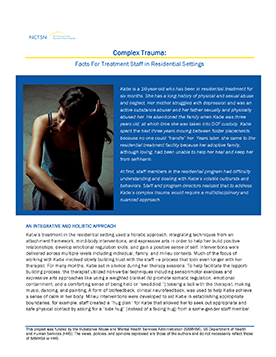
Complex Trauma: Facts for Treatment Staff in Residential Settings [8]

Type: Fact Sheet

Details the importance of a holistic, multidisciplinary, multi-level approach to addressing the needs of youth with complex trauma in residential treatment settings.

view [8]
NCTSN Resource

Victimization and Juvenile Offending [9]

Type: Fact Sheet

Discusses the correlation between victimization and juvenile offending.

view [9]
NCTSN Resource

Empowering Justice: Addressing Trauma in the Juvenile System [10]

Type: Webinar

Explores both the historical and current causes for disproportionality.

view [10]
NCTSN Resource

Assisting Commercially Sexually Exploited Youth in the Juvenile Justice System [11]

Type: Webinar

Gives an overview of current issues and challenges for law enforcement and the juvenile justice system in assisting children and adolescents who face commercial sexual exploitation.

view [11]
NCTSN Resource

Assessing Exposure to Psychological Trauma and Post-Traumatic Stress in the Juvenile Justice... [12]

Type: Fact Sheet

Explores the importance, clinical considerations, and approaches to assessing for psychological trauma and posttraumatic stress with youth in the juvenile justice population.

view [12]

Pages

  • FIRST [13]
  • PREVIOUS [14]
  • 1 [13]
  • 2 [14]
  • 3
  • 4 [15]
  • 5 [16]
  • NEXT [15]
  • LAST [16]

Source URL:https://nctsn.org/audiences/justice-system-professionals?page=2

Links
[1] https://nctsn.org/resources/trauma-informed-juvenile-court-self-assessment [2] https://nctsn.org/resources/trauma-informed-legal-advocacy-a-resource-for-juvenile-defense-attorneys [3] https://nctsn.org/resources/using-secondary-traumatic-stress-core-competencies-trauma-informed-supervision [4] https://nctsn.org/resources/nctsn-national-juvenile-probation-officer-survey [5] https://nctsn.org/resources/trauma-what-child-welfare-attorneys-should-know [6] https://nctsn.org/resources/complex-trauma-juvenile-justice-system-involved-youth [7] https://nctsn.org/resources/complex-trauma-facts-directors-administrators-and-staff-residential-settings [8] https://nctsn.org/resources/complex-trauma-facts-treatment-staff-residential-settings [9] https://nctsn.org/resources/victimization-and-juvenile-offending [10] https://nctsn.org/resources/empowering-justice-addressing-trauma-in-the-juvenile-justice-system [11] https://nctsn.org/resources/assisting-commercially-sexually-exploited-youth-juvenile-justice-system [12] https://nctsn.org/resources/assessing-exposure-psychological-trauma-and-post-traumatic-stress-juvenile-justice [13] https://nctsn.org/print/900 [14] https://nctsn.org/print/900?page=1 [15] https://nctsn.org/print/900?page=3 [16] https://nctsn.org/print/900?page=4