The National Child Traumatic Stress Network
Published on The National Child Traumatic Stress Network (https://nctsn.org)

Home > Justice System Professionals

Children who come to the attention of the juvenile justice system are a challenging and underserved population. The National Child Traumatic Stress Network has developed resources to help juvenile justice professionals understand and provide trauma-focused services to these youth. These resources include tools and materials for building skills and increasing knowledge about childhood trauma to help judges, attorneys, law enforcement, probation officers, frontline residential staff, mental health personnel, and caregivers understand and respond to the needs of traumatized children. In addition to the NCTSN resources highlighted below, Justice System Professionals can learn more about creating trauma-informed Justice Systems in the Trauma-Informed Care section of this website.

NCTSN Resource

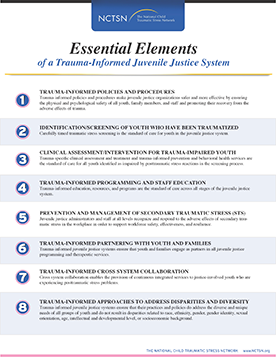
Essential Elements of a Trauma-Informed Juvenile Justice System [1]

Type: Resource Guide

Helps programs who work with justice-involved youth better understand the steps to take to recognize and respond to the trauma-related needs of youth, family members, and staff working in the justice system.

view [1]
NCTSN Resource

Trauma among Girls in the Juvenile Justice System [2]

Type: Fact Sheet

Gives details about the growing number of girls in the juvenile justice.

view [2]
NCTSN Resource

Trauma-Focused Interventions for Youth in the Juvenile Justice System [3]

Type: Fact Sheet

Describes evidence-informed interventions for youth involved in the juvenile justice system.

view [3]
NCTSN Resource

Racial Disparities and the Juvenile Justice System: A Legacy of Trauma [4]

Type: Fact Sheet

Outlines the historical context of racial disparities and highlights how systems can move forward to reduce these racial disparities, including by framing the issue so that practical and pro-active discussion can move beyond assigning blame.

view [4]
NCTSN Resource

The Role of Family Engagement in Creating Trauma-Informed Juvenile Justice Systems [5]

Type: Fact Sheet

Outlines the role of family engagement in creating trauma-informed juvenile justice systems.

view [5]
NCTSN Resource

Trauma and the Environment of Care in Juvenile Institutions [6]

Type: Fact Sheet

Outlines the environment of care in juvenile institutions.

view [6]
NCTSN Resource

Cross-System Collaboration [7]

Type: Fact Sheet

Outlines practice examples for continuity of care and collaboration across systems, a vital activity for youth involved in multiple service systems. This brief, written by Macon Stewart from the Center for Juvenile Justice Reform describes its Youth Practice Model.

view [7]
NCTSN Resource

Trauma-Informed Assessment and Intervention [8]

Type: Fact Sheet

Outlines the importance of trauma-informed assessment and intervention in the juvenile justice system.

view [8]
NCTSN Resource

Trauma-Informed Juvenile Justice Roundtable: Current Issues and New Directions in Creating Trauma... [9]

Type: Fact Sheet

Provides an introduction to the NCTSN Trauma-Informed Juvenile Justice Roundtable.

view [9]
NCTSN Resource

Birth Parents with Trauma Histories in the Child Welfare System: A Guide for Court-Based Child... [10]

Type: Fact Sheet

Highlights the importance for court-based advocates to understand the serious consequences that trauma histories can have for birth parents and the subsequent potential impact on their parenting.

view [10]
NCTSN Resource

NCTSN Bench Cards for the Trauma-Informed Judge [11]

Type: Special Resource

Provides judges with useful questions and guidelines to help make decisions based on the emerging scientific findings in the traumatic stress field. These bench cards assist judges and court-appointed professionals doing mental health assessment of children.

view [11]
NCTSN Resource

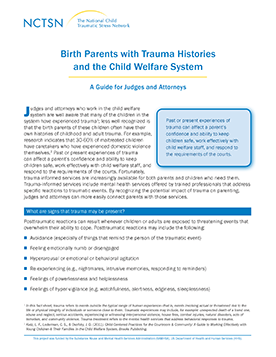
Birth Parents with Trauma Histories and the Child Welfare System: A Guide for Judges and Attorneys [12]

Type: Fact Sheet

Provides guidance to judges and attorneys on how to recognize trauma and its effects on birth parents. This fact sheet helps judges and attorneys recognize the potential impact of trauma on parenting.

view [12]

Pages

  • FIRST [13]
  • PREVIOUS [14]
  • 1 [13]
  • 2 [15]
  • 3 [14]
  • 4
  • 5 [16]
  • NEXT [16]
  • LAST [16]

Source URL:https://nctsn.org/audiences/justice-system-professionals?page=3

Links
[1] https://nctsn.org/resources/essential-elements-trauma-informed-juvenile-justice-system [2] https://nctsn.org/resources/trauma-among-girls-juvenile-justice-system [3] https://nctsn.org/resources/trauma-focused-interventions-youth-juvenile-justice-system [4] https://nctsn.org/resources/racial-disparities-and-juvenile-justice-system-legacy-trauma [5] https://nctsn.org/resources/role-family-engagement-creating-trauma-informed-juvenile-justice-systems [6] https://nctsn.org/resources/trauma-and-environment-care-juvenile-institutions [7] https://nctsn.org/resources/cross-system-collaboration [8] https://nctsn.org/resources/trauma-informed-assessment-and-intervention [9] https://nctsn.org/resources/trauma-informed-juvenile-justice-roundtable-current-issues-and-new-directions-creating [10] https://nctsn.org/resources/birth-parents-trauma-histories-child-welfare-system-guide-court-based-child-advocates [11] https://nctsn.org/resources/nctsn-bench-cards-trauma-informed-judge [12] https://nctsn.org/resources/birth-parents-trauma-histories-and-child-welfare-system-guide-judges-and-attorneys [13] https://nctsn.org/print/900 [14] https://nctsn.org/print/900?page=2 [15] https://nctsn.org/print/900?page=1 [16] https://nctsn.org/print/900?page=4