
NCTSN Resource
NCTSN Financing and Sustainability Survey Report [3]
Type: Resource Guide
Provides the summary results of a 2016 NCTSN member survey about financial sustainability.

The National Child Traumatic Stress Network (NCTSN) was created by Congress in 2000 as part of the Children’s Health Act to raise the standard of care and increase access to services for children and families who experience or witness traumatic events. This unique network of frontline providers, family members, researchers, and national partners is committed to changing the course of children’s lives by improving their care and moving scientific gains quickly into practice across the US. The NCTSN is administered by the Substance Abuse and Mental Health Services Administration (SAMHSA) and coordinated by the UCLA-Duke University National Center for Child Traumatic Stress (NCCTS).
Collaborative work with Policy Makers has been an essential part of the mission and activities of the NCTSN since the beginning. This website provides a range of resources for policy makers and other stakeholders who are seeking to better understand the prevalence and consequences of child traumatic stress, as well as solutions and policy implications. In addition to the NCTSN resources highlighted below, Policy Makers can learn more about the NCTSN in the About Us [1] section of this website and particularly the Policy Issues [2] page.
Provides the summary results of a 2016 NCTSN member survey about financial sustainability.

Explores policy challenges and lessons learned in promoting and supporting trauma-informed schools.

Provides an overview of several national policy challenges and solutions in the area of trauma and substance use.

Highlights two examples of state-based child trauma policy innovations. This webinar discuses the many states playing a leadership role in enacting and implementing policies to support trauma-informed services for children and families.

Features leading child and adolescent experts speaking about their recommendations for effectively addressing policy challenges in implementing integrated care.
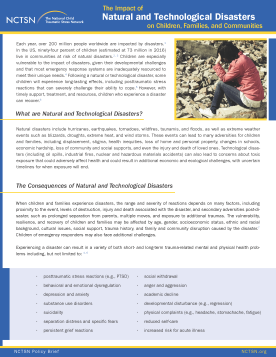
Provides information to policymakers about the impact of natural and technological disasters on children, families, and communities.

Addresses several local, state, and federal policy issues. This webinar series includes presentations from key policy experts, NCTSN members, affiliates, and partners who have played a leadership role in child trauma policy efforts.

Guides participants in understanding the Defending Childhood Initiative and its policy implications for the child trauma field.
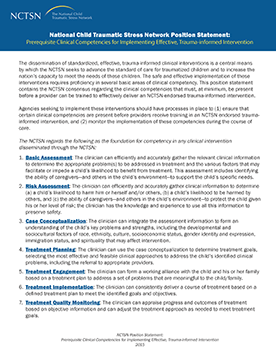
Guides agency leaders, clinicians, trainers, and others in optimizing service provision to children and families affected by trauma.
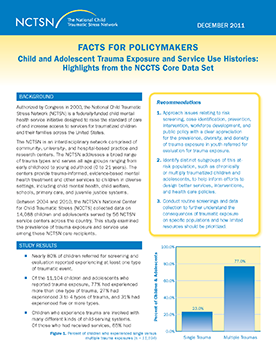
Describes the prevalence of trauma exposure and service use among NCTSN children in the Core Data Set and offers the study's results, recommendations, and policy implications.
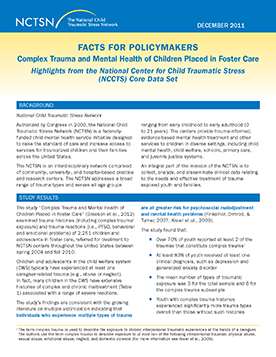
Describes the complex trauma and mental health of children placed in foster care among NCTSN care recipients as well as policy recommendations.
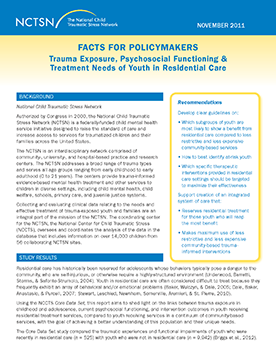
Describes child and adolescent trauma exposure and psychosocial functioning among NCTSN care recipients in residential care.
Links
[1] https://nctsn.org/about-us
[2] https://nctsn.org/about-us/policy-issues
[3] https://nctsn.org/resources/nctsn-financing-and-sustainability-survey-report
[4] https://nctsn.org/resources/policy-issues-implementing-trauma-informed-schools
[5] https://nctsn.org/resources/substance-use-and-trauma-policy-challenges-and-solutions
[6] https://nctsn.org/resources/state-policy-innovations-child-trauma-lessons-north-carolina-and-arkansas
[7] https://nctsn.org/resources/effectively-addressing-policy-challenges-implementing-integrated-care-child-trauma
[8] https://nctsn.org/resources/impact-natural-and-technological-disasters-children-families-and-communities-policy-brief
[9] https://nctsn.org/resources/policy
[10] https://nctsn.org/resources/understanding-defending-childhood-initiative-policy-implications-child-trauma-field
[11] https://nctsn.org/resources/prerequisite-clinical-competencies-implementing-effective-trauma-informed-intervention
[12] https://nctsn.org/resources/core-data-set-policy-brief-child-and-adolescent-trauma-exposure-and-service-use-histories
[13] https://nctsn.org/resources/core-data-set-policy-brief-complex-trauma-and-mental-health-children-placed-foster-care
[14] https://nctsn.org/resources/core-data-set-policy-brief-trauma-exposure-psychosocial-functioning-and-treatment-needs
[15] https://nctsn.org/print/905
[16] https://nctsn.org/print/905?page=2