The National Child Traumatic Stress Network
Published on The National Child Traumatic Stress Network (https://nctsn.org)

Home > School Personnel

Research suggests that approximately 25% of American children will experience at least one traumatic event by the age of 16. A child's reactions to trauma can interfere considerably with learning and/or behavior at school. Schools serve as a critical system of support for children who have experienced trauma. Administrators, teachers, and staff can help reduce the effects of trauma on children by recognizing trauma responses, accommodating and responding to traumatized students within the classroom, and referring children to outside professionals when necessary. The National Child Traumatic Stress Network has developed tools and materials to help educators, school staff, and administrators understand and respond to the specific needs of traumatized children. In addition to the NCTSN resources highlighted below, School Personnel can learn more about creating trauma-informed schools in the Trauma-Informed Care section of this website.

NCTSN Resource

Creating, Supporting, and Sustaining Trauma-Informed Schools: A System Framework [1]

Type: Resource Guide

Presents a tiered approach to creating a trauma-informed school environment that addresses the needs of all students, staff, administrators, and families who might be at risk for experiencing the symptoms of traumatic stress.

view [1]
NCTSN Resource

Age-Related Reactions to a Traumatic Event [2]

Type: Fact Sheet

Describes how young children, school-age children, and adolescents react to traumatic events and offers suggestions on how parents and caregivers can help and support them.

view [2]
NCTSN Resource

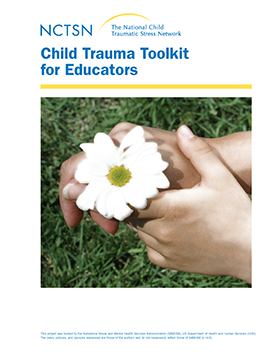
Child Trauma Toolkit for Educators [3]

Type: Special Resource

Provides school administrators, teachers, staff, and concerned parents with basic information about working with traumatized children in the school system.

view [3]
NCTSN Resource

What Is Child Traumatic Stress? [4]

Type: Fact Sheet

Defines child traumatic stress. This fact sheet gives an overview of trauma, describes traumatic stress symptoms, and ways children may be impacted.

view [4]
NCTSN Resource

Understanding and Addressing the Intersection of Substance Use and Child Trauma: For Teachers and... [5]

Type: Fact Sheet

Helps school professionals understand how trauma and substance use can affect students’ behavior, learning, and well-being within school settings.

view [5]
NCTSN Resource

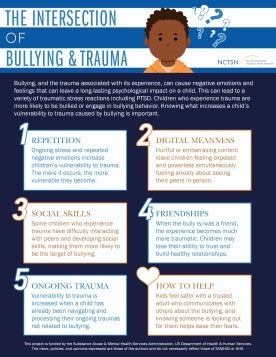
Bullying and Trauma [6]

Type: Infographic

Highlights the intersection between bullying and trauma and offers ways adults can help them feel safe and supported.

view [6]
NCTSN Resource

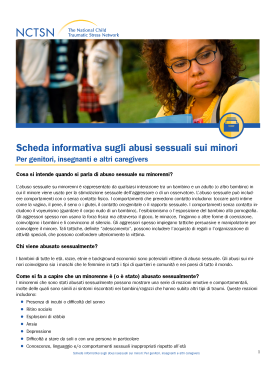
Child Sexual Abuse Fact Sheet: For Parents, Teachers, and Other Caregivers (in Italian) [7]

Type: Fact Sheet

Defines and answers commonly-asked questions about child sexual abuse. This fact sheet outlines myths and facts about child sexual abuse and provides tips to help protect children. Translated in 2025.

view [7]
NCTSN Resource

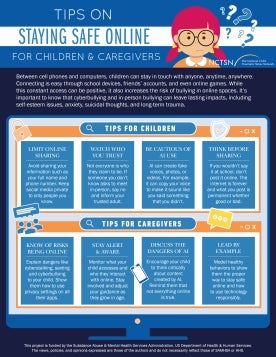
Staying Safe Online [8]

Type: Infographic

Offers practical tips for children and caregivers to stay safe online, recognize the risks of cyberbullying and AI misuse, and promote healthy, responsible digital habits.

view [8]
NCTSN Resource

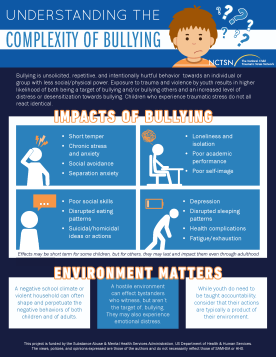
The Complexity of Bullying [9]

Type: Infographic

Explores the complex relationship between bullying and trauma. Highlights how both targets and perpetrators can be affected by their environments and how these experiences shape emotional and behavioral responses.

view [9]
NCTSN Resource

Child Sex Trafficking: A Fact Sheet for Educational Professionals [10]

Type: Fact Sheet

Offers information regarding child sex trafficking to educational professionals.

view [10]
NCTSN Resource

Child Neglect and Trauma: A Fact Sheet for Providers [11]

Type: Fact Sheet

Offers child-serving providers information about child neglect and trauma.

view [11]
NCTSN Resource

NCTSN Trauma-Informed Organizational Assessment (TIOA) Course [12]

Type: Special Resource

Helps organizations assess their current practices in the context of serving children and families who have experienced trauma. It is an important part of an organizational transformation process to create trauma-informed organizations.

view [12]

Pages

  • 1
  • 2 [13]
  • 3 [14]
  • 4 [15]
  • 5 [16]
  • 6 [17]
  • NEXT [13]
  • LAST [17]

Source URL:https://nctsn.org/audiences/school-personnel

Links
[1] https://nctsn.org/resources/creating-supporting-and-sustaining-trauma-informed-schools-system-framework [2] https://nctsn.org/resources/age-related-reactions-traumatic-event [3] https://nctsn.org/resources/child-trauma-toolkit-educators [4] https://nctsn.org/resources/what-child-traumatic-stress [5] https://nctsn.org/resources/substance-use-school-professionals [6] https://nctsn.org/resources/nctsn-bullying-trauma [7] https://nctsn.org/resources/child-sexual-abuse-fact-sheet-parents-teachers-and-other-caregivers-it [8] https://nctsn.org/resources/nctsn-online-safety [9] https://nctsn.org/resources/complexity-of-bullying [10] https://nctsn.org/resources/child-sex-trafficking-a-fact-sheet-for-educational-professionals [11] https://nctsn.org/resources/child-neglect-and-trauma-a-fact-sheet-for-providers [12] https://nctsn.org/resources/nctsn-trauma-informed-organizational-assessment-course [13] https://nctsn.org/print/901?page=1 [14] https://nctsn.org/print/901?page=2 [15] https://nctsn.org/print/901?page=3 [16] https://nctsn.org/print/901?page=4 [17] https://nctsn.org/print/901?page=5