The National Child Traumatic Stress Network
Published on The National Child Traumatic Stress Network (https://nctsn.org)

Home > School Personnel

Research suggests that approximately 25% of American children will experience at least one traumatic event by the age of 16. A child's reactions to trauma can interfere considerably with learning and/or behavior at school. Schools serve as a critical system of support for children who have experienced trauma. Administrators, teachers, and staff can help reduce the effects of trauma on children by recognizing trauma responses, accommodating and responding to traumatized students within the classroom, and referring children to outside professionals when necessary. The National Child Traumatic Stress Network has developed tools and materials to help educators, school staff, and administrators understand and respond to the specific needs of traumatized children. In addition to the NCTSN resources highlighted below, School Personnel can learn more about creating trauma-informed schools in the Trauma-Informed Care section of this website.

NCTSN Resource

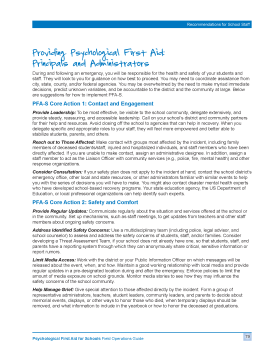
Providing Psychological First Aid: Principals and Administrators [1]

Type: Fact Sheet

Offers principals and administrators a quick resource for using the Core Actions of Psychological First Aid in response to an emergency event on school grounds.

view [1]
NCTSN Resource

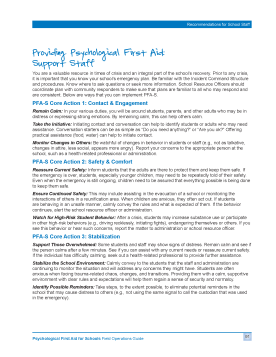
Providing Psychological First Aid: Support Staff [2]

Type: Fact Sheet

Offers school support staff a quick resource for using the Core Actions of Psychological First Aid in response to an emergency event on school grounds.

view [2]
NCTSN Resource

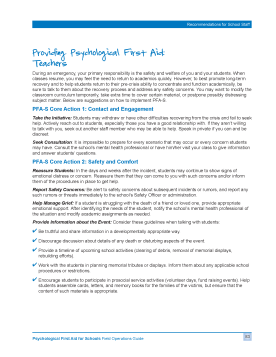
Providing Psychological First Aid: Teachers [3]

Type: Fact Sheet

Offers teachers a quick resource for using the Core Actions of Psychological First Aid in response to an emergency event on school grounds.

view [3]
NCTSN Resource

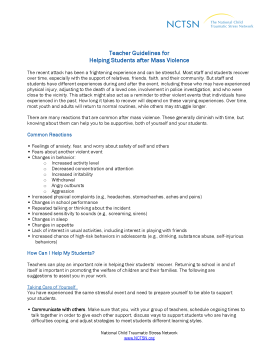
Teacher Guidelines for Helping Students after Mass Violence [4]

Type: Fact Sheet

Offers teachers guidance on helping students after a mass violence event. This fact sheet describes common reactions students may have, how teachers and school staff can help, as well as engage in self-care after a mass violence event.

view [4]
NCTSN Resource

Preparing Our Children for Emergencies [5]

Type: Webinar

Describes how best to prepare our children for emergencies. This webinar discusses how to prepare for events from a community preparedness and resilience standpoint, as well as emergency preparedness within school settings.

view [5]
NCTSN Resource

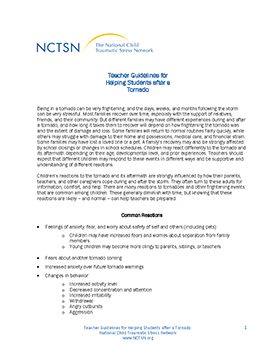
Teacher Guidelines for Helping Students after a Tornado [6]

Type: Fact Sheet

Offers teachers guidance on helping students after a tornado. This fact sheet describes common reactions students may have, how teachers and school staff can help, as well as engage in self-care after a tornado.

view [6]
NCTSN Resource

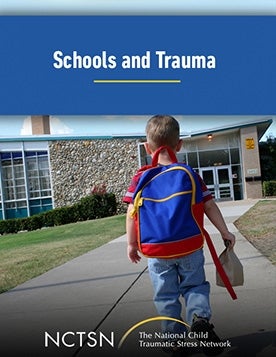
Schools and Trauma [7]

Type: Webinar

Focuses on partnering with schools to enhance mental health and trauma-informed services designed to inform both school personnel and mental health professionals about the impact of traumatic events.

view [7]
NCTSN Resource

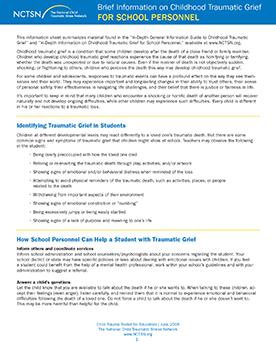
Brief Information on Childhood Traumatic Grief for School Personnel [8]

Type: Fact Sheet

Offers information on childhood traumatic grief. This fact sheet provides descriptions of childhood traumatic grief, normal and typical grief, and what to do for childhood traumatic grief for teachers and school personnel.

view [8]
NCTSN Resource

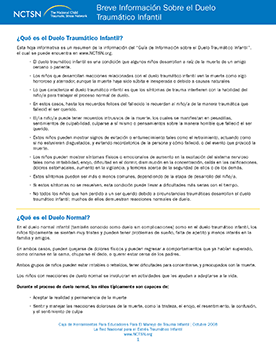
Breve Información Sobre el Duelo Traumático Infantil Para Personal de la Escuela [9]

Type: Fact Sheet

Ofrece información sobre el duelo traumático infantil. Este folleto informativo define lo que es del duelo traumático infantil, el duelo típico y normal y describe qué pueden hacer los maestros y el personal de la escuela ante el duelo traumático.

view [9]
NCTSN Resource

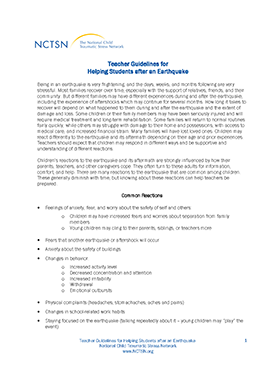
Teacher Guidelines for Helping Students after an Earthquake [10]

Type: Fact Sheet

Offers teachers guidance on helping students after an earthquake. This fact sheet describes common reactions students may have, how teachers and school staff can help, as well as engage in self-care after an earthquake.

view [10]
NCTSN Resource

Response and Recovery after School Violence [11]

Type: Webinar

Presents a process for threat assessment and management in an educational setting. This webinar addresses the process of assessing risks of a particular individual or group of individuals and the design and implementation of management strategies to reduce those risks.

view [11]
NCTSN Resource

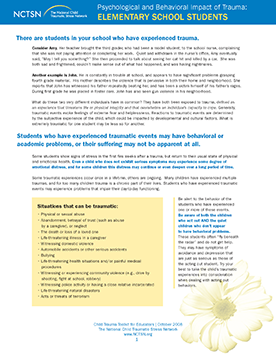
Psychological and Behavioral Impact of Trauma: Elementary School Students [12]

Type: Fact Sheet

Describes the psychological and behavioral impact of trauma on elementary school students.

view [12]

Pages

  • FIRST [13]
  • PREVIOUS [14]
  • 1 [13]
  • 2 [15]
  • 3 [14]
  • 4
  • 5 [16]
  • 6 [17]
  • NEXT [16]
  • LAST [17]

Source URL:https://nctsn.org/audiences/school-personnel?page=3

Links
[1] https://nctsn.org/resources/providing-psychological-first-aid-principals-and-administrators [2] https://nctsn.org/resources/providing-psychological-first-aid-support-staff [3] https://nctsn.org/resources/providing-psychological-first-aid-teachers [4] https://nctsn.org/resources/teacher-guidelines-helping-students-after-mass-violence [5] https://nctsn.org/resources/preparing-our-children-emergencies [6] https://nctsn.org/resources/teacher-guidelines-helping-students-after-tornado [7] https://nctsn.org/resources/schools-and-trauma [8] https://nctsn.org/resources/brief-information-childhood-traumatic-grief-school-personnel [9] https://nctsn.org/resources/breve-informacion-sobre-el-duelo-traumatico-infantil-para-personal-de-la-escuela [10] https://nctsn.org/resources/teacher-guidelines-helping-students-after-earthquake [11] https://nctsn.org/resources/response-and-recovery-after-school-violence [12] https://nctsn.org/resources/psychological-and-behavioral-impact-trauma-elementary-school-students [13] https://nctsn.org/print/901 [14] https://nctsn.org/print/901?page=2 [15] https://nctsn.org/print/901?page=1 [16] https://nctsn.org/print/901?page=4 [17] https://nctsn.org/print/901?page=5